Disability care and inclusion blog – 3Sixty5 Care

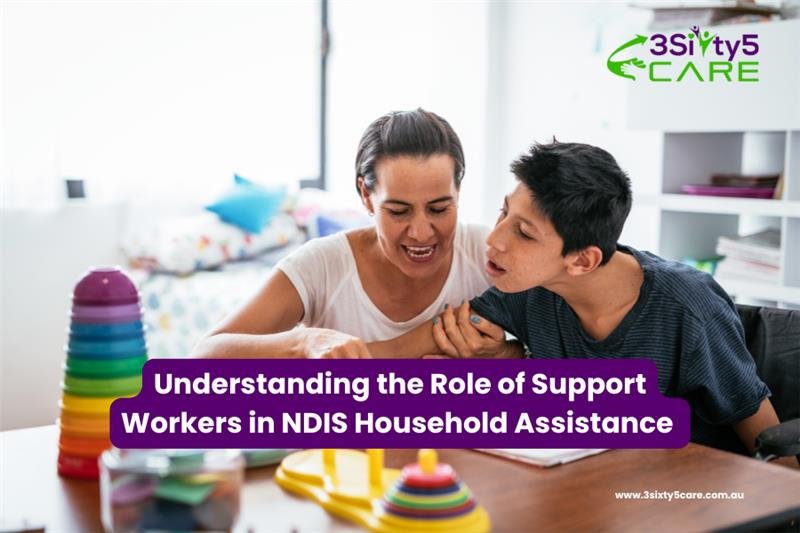
Understanding the Role of Support Workers in NDIS Household Assistance

National Disability Insurance Scheme (NDIS) remains a revolutionary program to the people with disabilities in Australia. The NDIS makes people more independent by giving them access to essential services and providing them with the opportunity to more actively contribute to the life of their communities and advance their personal quality of life.

NDIS household task support is one of the most important services offered in its core services, which allow people to stay in their homes and live there safely. At 3Sixty5 Care, a registered NDIS provider in Melbourne, we understand that a clean, organized home can be life changing.

We are more than cleaning facilitators as our experienced NDIS support workers will provide you with. Their care includes specific and personal support to fit a particular participant based on their goals and issues.

What Are NDIS Household Tasks?

NDIS household assignments comprise household activities that are paid for under the Core Supports segment of the NDIS plan. They are daily tasks which could not be performed by individuals as they could be experiencing physical, intellectual or psychosocial disabilities.

Common NDIS Household Tasks Include:
These tasks help to maintain a healthy and safe home environment and can be delivered regularly or as needed, depending on your support plan and preferences.

The Role of a Support Worker in NDIS Household Assistance

The support workers are very vital in enabling the NDIS participants to live independently. Although household support is its major role, they usually have increased roles and have the responsibility to suit the needs of the participant, which is usually varied.
1. Domestic Assistance and Cleaning Support

Domestic cleaning is the most popular type of NDIS household support. Support workers will assist in doing regular cleaning duties that could be physically rigorous or unsafe to undertake by the participants independently. They make sure that you live in a healthy, clutter-free environment that is comfortable.

No matter whatever the day is, be it cleaning the toilet, polishing floors or cleaning kitchen counters, our 3Sixty5 Care team does not leave any work undone with a sense of the needs and privacy of a participant.
2. Meal Preparation and Cooking
To ensure that healthy meals are ready, support workers have a chance to help participants learn to prepare them. This may involve preparing the meals entirely depending on the level of need, assistance in kitchen lessons to develop the skills, or advice on how to be safe in the kitchen and supervision.
NDIS funding could also cover NDIS assistive items to complete tasks around the house, with actual examples being adaptive cooking equipment or even safety equipment that enables the participants to become more independent in food preparation.
3. Laundry and Linen Care
To some people, duties such as washing clothes or picking up a laundry basket are too much to handle. Sorters, washers, dryers, folders and put-aways are part of what the support workers can do to make your home smell good and be orderly.

Beyond Cleaning: Other Valuable Support Services

Although the focus of the household activities remains the central aspect, NDIS support workers usually perform a multidimensional role in the care of the participants. This is the reason that it may be worthwhile to select a provider that is experienced and comprehensive like 3Sixty5 Care and that it may help your experience considerably.
1. Personal Care Assistance
The support workers frequently assist the personal hygiene and grooming like bathing, dressing and toileting. They do all these according to dignity, comfort and respect.
2. Skill Development and Daily Living Training
In addition to doing household chores, the support workers assist the participants in developing fundamental skills in life such as basic cooking, cleaning, budgeting, and planning. Such skills enhance more independence and confidence.
3. Social and Emotional Support
A good number of participants have few social networks. A support worker offers companionship and motivates a person to participate in community activities, classes, and other social groups. Such contacts might be extremely powerful and assist in lessening solitude or isolation.
4. Transportation Assistance
Support staff are allowed to escort participants to health facilities, shopping centers, fun outings, or job placements. This is secure and robust transportation. There are those who even help with mobility and vehicle transfer.
5. Healthcare and Medication Management
At the point of sixty percent, support workers can assist with medical-related activities such as wound management, reminders of taking medication, or contacting healthcare providers to watch over medical conditions, given the adequate qualifications.

Assistive Products for Household Tasks

NDIS participants may also be eligible for assistive products that make household tasks easier or safer. These can include:

At 3Sixty5 Care, we can help you identify and implement assistive products into your daily routine. We offer both hands-on support and guidance on how to use them effectively.

Benefits of Working with a Support Worker for NDIS Household Tasks

Partnering with an experienced support worker offers a range of benefits for NDIS participants.

1. Independence and Empowerment

The participants learn to live with more independence and confidence as they get support where it is required as well as are enabled to develop new skills.

2. Improved Physical and Mental Health

A healthy living environment is physically better as well as organised and clean. Routine, companionship, and less everyday stress also help improve emotional health.

3. Access to the Community

Support workers facilitate the participants to be more out and about and be involved in social activities, employment or education, which makes them more fulfilled.

4. Peace of Mind for Families

The reassurance a family gets of knowing that an attentive person with sufficient training is offering high-quality support lowers the burden on the caregiver.

NDIS Household Tasks Core Supports Funding — and What Domestic Assistance Support Workers Actually Do

One of the most common questions participants and families ask is a simple one: how does the NDIS actually fund household tasks, and how do I make sure it’s in my plan? Understanding the funding mechanics is important — not just for accessing support, but for making sure your plan is set up correctly at your next NDIS review.

Which Budget Funds Household Tasks?

NDIS household tasks are funded under the Core Supports budget, specifically under the support category Assistance with Daily Life (Support Category 01). This is the same category that funds personal care, overnight support, and assistance with daily activities — making it the most flexible and frequently used budget in the NDIS.

Within Assistance with Daily Life, the specific line items that fund household tasks include:
Support ItemWhat It FundsAssistance with Daily Life — StandardRegular domestic assistance, cleaning, laundry, and meal preparation by a support workerAssistance with Daily Life — Evening/WeekendThe same supports delivered outside standard weekday hours, funded at a higher rateHouse Cleaning and Other Household ActivitiesRoutine cleaning and household maintenance tasksAssistance with Daily Life — SILHousehold task support delivered within a Supported

Core Supports funding is the most flexible budget in an NDIS plan — in most cases, participants can use unspent funds from one Core support category (such as transport) to cover another (such as household tasks), giving you real flexibility in how you manage your support hours across the year.
How Much Funding Will I Receive for Household Tasks?

The NDIS does not fund household tasks on a flat-rate basis. Instead, the amount allocated in your plan is determined during the planning process based on your assessed functional capacity — that is, your ability to perform household tasks independently given your disability, health condition, or impairment. The planner or Local Area Coordinator (LAC) will consider which tasks you cannot do at all, which you can do partially with assistance, and which assistive products might reduce the need for direct support.

This is why the evidence you and your support team bring to a plan meeting or review matters so much. Functional assessments from occupational therapists, detailed reports from your current support workers, and your own account of how household tasks affect your daily life all contribute to the level of funding approved. Participants who arrive at plan reviews with clear, task-specific evidence consistently achieve better household task funding outcomes than those who rely on general descriptions.

How Domestic Assistance Support Workers Are Funded Differently from Commercial Cleaners
This distinction matters and is frequently misunderstood. A commercial or general disability cleaning service charges for cleaning labour only. An NDIS domestic assistance support worker is funded to do more: they are delivering a support that is directly connected to your disability-related need to maintain a safe, hygienic, and functional home environment. 

This means the support is funded because of your functional limitation — not simply because the task needs doing.
As a practical consequence, NDIS domestic assistance support workers can combine household task support with other supports in the same visit: helping with meal preparation before doing the kitchen clean, assisting with laundry while providing companionship and conversation, or supporting skill development by guiding participants through tasks rather than simply completing them. A commercial cleaning service cannot and does not do any of this.

What NDIS Domestic Assistance Support Workers Are Trained to Do

At 3SIXTY5 CARE, our domestic assistance support workers are not general cleaners allocated to disability households. They are trained NDIS support workers whose household task delivery is built around each participant’s individual support plan. Specifically, they are trained and expected to:
 
Deliver household task support in a way that preserves the participant’s dignity and respects the privacy of their home
Identify and report changes in the participant’s condition or home environment that may affect their safety or support needs
Adjust the level of assistance provided based on the participant’s capacity on any given day — doing more on difficult days, doing less and building independence on better days
Support skill development by coaching participants through tasks rather than doing everything for them, where the participant’s goals include building household independence
Document the support delivered accurately for plan review evidence purposes
Recognise when a household safety concern — such as a trip hazard, expired medication, or inadequate food storage — requires escalation
 
This is the difference between a domestic assistance support worker and a cleaning service: the support worker is present in a care capacity, not just a task-completion capacity.
 
Disability Cleaning Services in Melbourne — Why Local Provider Knowledge Matters
For participants across Melbourne’s western suburbs — including Melton, Cobblebank, Rockbank, Caroline Springs, and Bacchus Marsh — choosing a registered local NDIS provider for household task support rather than a general disability cleaning service has practical advantages. A local provider understands local service area geography, can deploy consistent workers to the same participant rather than rotating contractors, and is accountable to the NDIS Quality and Safeguards Commission in a way that unregistered commercial cleaners are not.

At 3SIXTY5 CARE, we deliver NDIS domestic assistance and household task support across Melbourne’s west from our base in Cobblebank. Our support workers are local, consistent, and trained — not subcontracted cleaners. Every household task visit is documented, every support worker holds a current NDIS Worker Screening clearance, and every service we deliver is backed by a service agreement that protects your rights as an NDIS participant.
 
Want to understand what household task support funding you’re entitled to? Contact 3SIXTY5 CARE and we’ll help you understand your Core Supports budget and what domestic assistance looks like in practice.

Who Can Benefit from Household Task Support?

A wide range of individuals can benefit from NDIS household support, including:

Whether you’re living with mobility challenges or cognitive impairments, our support workers will tailor assistance to your needs and goals.

Choosing the Right NDIS Support Worker in Melbourne

Finding the right support worker can change your life. When searching, consider:

The support workers we selected at 3Sixty5 Care are chosen by hand and they have been selected based on their compassion, experience and professionalism. We serve participants in Melbourne, and we provide the same high quality of local support you can trust.

Final Thoughts

The success of NDIS care circles around support workers. They do not only help with important NDIS household chores but also give emotional support, personal care, and help engage with the community that is more independent and gaining a satisfying life.
Be it cooking, cleaning, laundry, or social participation, you may require assistance. The 3Sixty5 Care team is there to assist you in every case. We are determined to give each player the ability to live the best life wherever they start.

Looking for NDIS Household Support in Melbourne?

Contact 3Sixty5 Care today to learn how our friendly, qualified support workers can make your daily life easier and more enjoyable.

NDIS Household Tasks & Domestic Assistance — FAQs

Q1. How is NDIS household tasks support funded — which budget does it come from?
NDIS household tasks are funded under Core Supports — Assistance with Daily Life. Funding is flexible and based on your functional needs and supporting evidence.
Q2. What is the difference between NDIS domestic assistance and a cleaning service?
NDIS domestic assistance is a disability support delivered by trained workers, while cleaning services only provide labour and are not part of NDIS support.
Q3. Can I use NDIS funding for cleaning services?
Only if the service is delivered by an NDIS provider and linked to your disability needs. General cleaning services are not covered.
Q4. What tasks can support workers help with?
Tasks include cleaning, laundry, meal preparation, and general home maintenance, as well as supporting independence skills.
Q5. How do I add household task support to my plan?
Provide functional evidence at your planning meeting, including OT reports and support documentation.
Q6. Does 3SIXTY5 CARE offer this support in Melbourne?
Yes. Services are available across Melbourne’s western suburbs with trained support workers.
Q7. Can support workers combine personal care and household tasks?
Yes. Both supports fall under Core Supports and can be delivered in the same visit.
Share post
Facebook
Twitter
LinkedIn
WhatsApp

Leave a Reply

Your email address will not be published. Required fields are marked *