
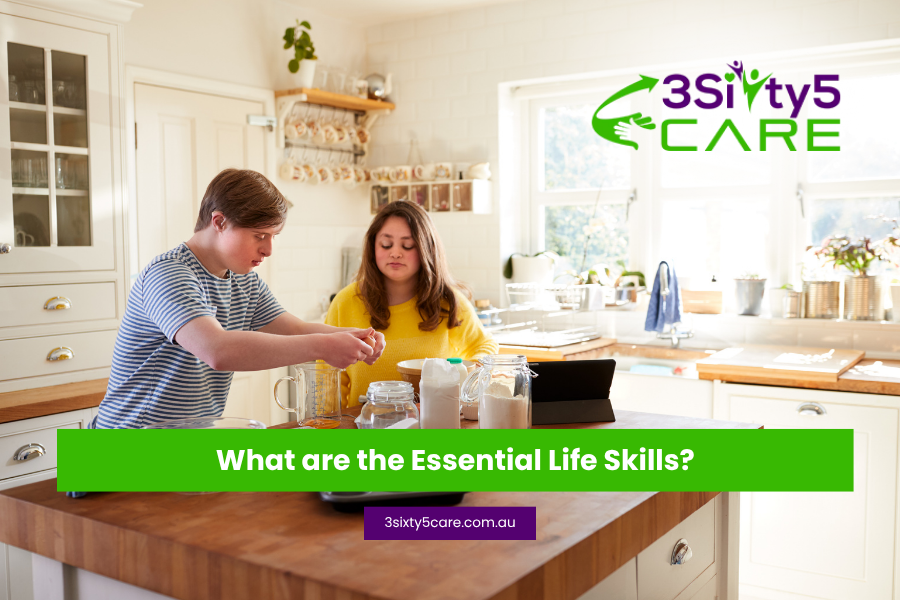
Below are some examples of common and very useful life skills which NDIS participants can be taught with the right support:
2. Cooking and Home Care
Understanding NDIS Skill Building Support: Funding, Structure, and What to Expect
When delivered by a registered NDIS provider like 3SIXTY5 CARE, they are structured, goal-directed supports funded through your NDIS plan and tied directly to measurable outcomes. Understanding the funding mechanics is what allows participants and families to access these supports confidently and make the most of every dollar in the plan.
Which NDIS Budget Funds Life Skills Development? NDIS life skills development in Melbourne is primarily funded under Capacity Building Supports — Support Category 9: Improved Daily Living. This is one of the most flexible and powerful budget lines in an NDIS plan, specifically designed to fund supports that build a participant’s independence and functional capacity over time.
Unlike Core Supports — which fund ongoing assistance with daily tasks — Capacity Building funding is intentionally invested in growth. The goal is that over time, with the right skill building support, a participant needs less ongoing help, not more. This distinction is important both for the participant’s sense of progress and for demonstrating value at plan reviews.
Capacity Building Category What It Covers Life Skills Examples Improved Daily Living (Cat. 9)Skill development programs, therapy, training for independence Cooking programs, budgeting practice, personal care routines, time management Increased Social and Community Participation (Cat. 4 — Core)Supported participation in community to practise skills in real settings Using public transport, shopping independently, attending community groups Improved Learning (Cat. 6)Education, training, and transition to employment support
Digital literacy, workplace readiness, communication skills
What an Independent Living Skills Program in Melbourne Actually Looks Like An independent living skills program in Melbourne delivered through 3SIXTY5 CARE is not a fixed curriculum.
How 3SIXTY5 CARE Supports Life Skill Development
3SIXTY5 CARE Melbourne, is a registered NDIS provider with a focus on really achieving progress and independence and that is why we are proud of it. Our life skill programs are developed in an easy-going style, very practical, and based on every participant’s individual goals.
- Personalized support plans –We start a very detailed plan by discussing and understanding everyone’s objectives and their most valuable qualities.
- Hands-on learning – Participants get to learn through doing real-life activities such as cooking, shopping, or using public transport.
- Encouraging environment – We take care to make a good and friendly place where the participants can easily and slowly learn the way they want.
- Experienced team – The friendly support workers of ours grant guidance and motivation to the participants, celebrating every small achievement.
- Focus on long-term growth – The aim is not merely to impart skills, but also to help the participants gain proficiency in using them in their daily lives.
Taking Steps Toward a More Independent Future
Frequently Asked Questions
How is NDIS life skills development funded in Melbourne?
NDIS life skills development in Melbourne is primarily funded under Capacity Building Supports — Improved Daily Living (Support Category 9) in your NDIS plan. This budget is specifically designed to fund structured programs and supports that build a participant's independence and functional capacity over time. Some life skills activities that involve practising skills in real-world community settings may also draw on Core Supports funding. Your Support Coordinator can identify the correct budget lines for specific activities and help ensure your plan reflects your life skills goals.
What is the difference between NDIS skill building support and regular personal care support?
NDIS skill building support is funded through Capacity Building and is focused on teaching, practising, and developing skills so a participant can eventually perform tasks more independently. Regular personal care support is funded through Core Supports and covers direct assistance with tasks a participant cannot currently do on their own. The key distinction is intent: skill building is an investment in future independence, while personal care support maintains daily functioning in the present. Many participants benefit from both, with skill building gradually reducing the need for ongoing personal care over time.
What does an independent living skills program in Melbourne include?
An independent living skills program in Melbourne typically includes personalised goal setting based on the participant's NDIS plan, structured sessions targeting practical daily skills such as cooking, budgeting, personal care, and time management, real-world practice in community settings such as local shops, public transport, and community spaces, consistent documentation of progress toward plan goals, and regular review to adjust the program as skills develop. At 3SIXTY5 CARE, programs are individually tailored and delivered in the environments where skills are most relevant to each participant's daily life.
Can life skills programs be included in any NDIS plan, or do I need a specific goal?
To access funded life skills development, your NDIS plan needs to include relevant goals — for example, "improve ability to prepare meals independently" or "develop confidence using public transport." Capacity Building funding is goal-linked, meaning the supports funded must demonstrably contribute to outcomes stated in your plan. If your current plan does not include life skills goals, raise this at your next planning meeting or request a plan review. A Support Coordinator or the 3SIXTY5 CARE team can assist you in framing goals that are likely to be supported by the NDIA.
How long does it take to see results from NDIS life skills development?
This varies significantly depending on the participant's starting point, the complexity of the skills being developed, the frequency of sessions, and the individual's learning style and pace. Some participants achieve meaningful independence in a specific skill area within a few weeks of consistent practice; others work on more complex goals over six to twelve months. What matters most is that progress is consistent, documented, and linked to goals — because this evidence supports continued Capacity Building funding at plan reviews, allowing the program to continue as long as it is generating genuine outcomes.
Can capacity building daily activities be delivered at home, or do participants need to attend a centre?
NDIS skill building support and capacity building daily activities can be delivered flexibly — at the participant's home, in community settings, or at a dedicated centre. 3SIXTY5 CARE primarily delivers life skills programs in the real-world environments where those skills will ultimately be used, as this approach produces stronger and more transferable outcomes than centre-only delivery. A combination of home-based sessions and community practice is often the most effective model for most participants.
How do I know if life skills development is working and making a difference?
Progress in an independent living skills program is measured against the specific goals set at the start of the program. 3SIXTY5 CARE documents each session, recording what was practised, the level of prompting required, and observable progress toward the participant's stated goals. Over time, a clear reduction in the level of support needed to complete a task is the most meaningful indicator of genuine skill development. This documentation also provides valuable evidence at NDIS plan reviews, demonstrating the real-world impact of Capacity Building funding.


